
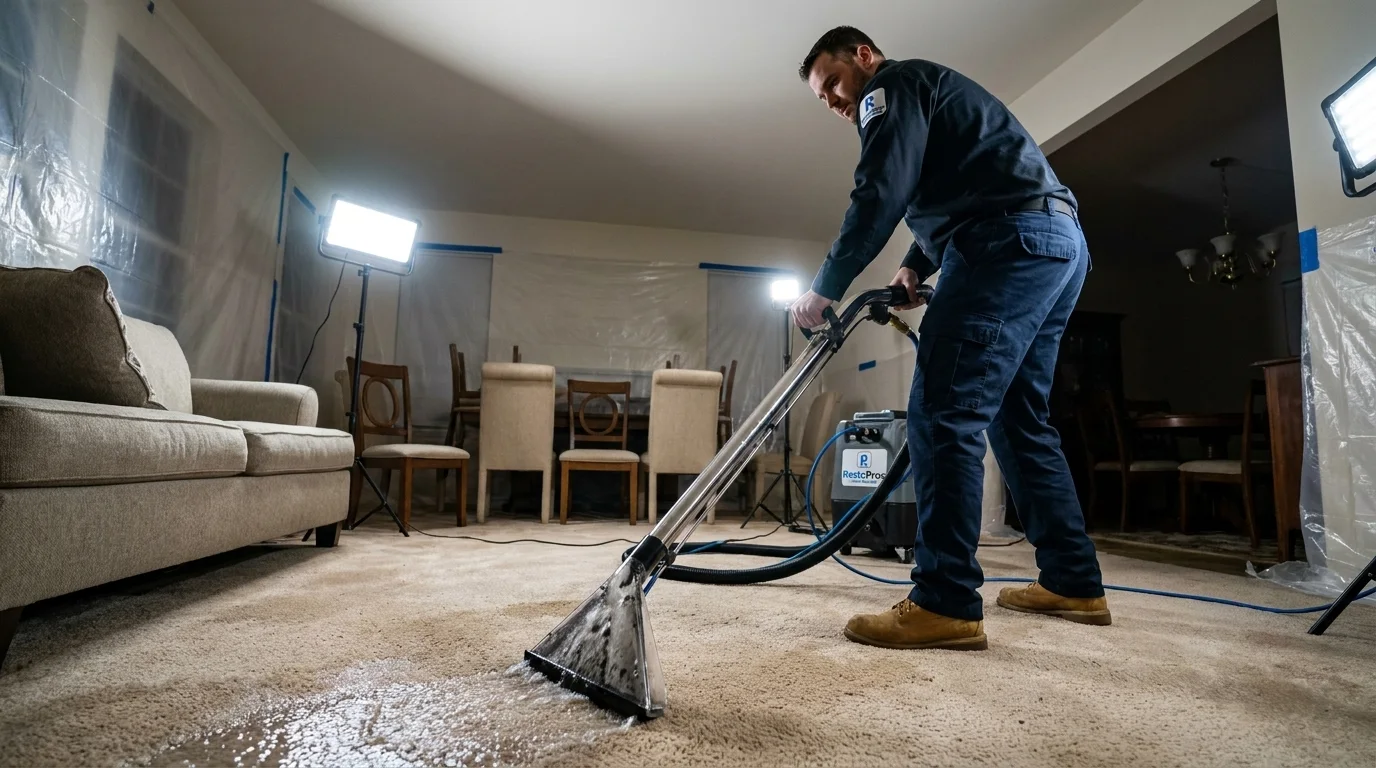
24/7 Emergency Water Removal & Cleanup in Rockville
24/7 emergency water removal & cleanup in Rockville and surrounding areas. IICRC-certified, insurance billing accepted. Call (240) 261-1639.
Water spreading across a Rockville basement floor or soaking into a hallway subfloor doesn’t wait for business hours. Within an hour, water wicks up drywall and under baseboards. Within 24 to 48 hours, untreated moisture in wall cavities and subfloor can start supporting mold growth. If you’re standing in water right now, call (240) 261-1639. We answer 24/7 and move fast to start extraction before the damage climbs higher up the structure.
What emergency water removal & cleanup actually involves
Emergency water removal is the physical pulling of standing and trapped water out of a structure, followed by targeted drying of everything the water touched but you can’t see. That’s two different jobs. The first is extraction: submersible pumps for deep standing water, truck-mounted or portable extractors for carpet, pad, and shallow pooling. The second is structural drying: industrial air movers positioned to push air across wet surfaces, and commercial dehumidifiers pulling moisture out of the air so materials can actually release the water they’ve absorbed.
The source matters as much as the volume. A supply line failure behind a washing machine is a different job than a sewer backup in a finished basement, even if both put down the same inch of water. Category 1 water (clean source, like a supply line) is handled differently than Category 2 (gray water, washing machine discharge) or Category 3 (sewage, groundwater, flooding), which require containment and in some cases removal of affected porous materials rather than drying them in place. Timelines run anywhere from same-day extraction with 3 to 5 days of monitored drying for a contained Category 1 loss, to longer when flooring, drywall, or insulation has to come out first.
Our process
- Extraction and source control. We identify and stop the active water source where possible, then begin pulling standing water with pumps and extractors, prioritizing rooms where water is migrating into adjacent spaces.
- Moisture mapping. We use moisture meters and thermal imaging to find water that has traveled into wall cavities, under flooring, and behind baseboards, areas that look dry on the surface but aren’t.
- Containment, when category demands it. For Category 2 or 3 water, we isolate affected areas with physical barriers to keep contaminated water and airborne particles from spreading to unaffected rooms.
- Structural drying with daily monitoring. Air movers and dehumidifiers go in immediately, and we return to re-check moisture readings, typically daily, adjusting equipment placement until materials read dry, not just until the floor looks dry.
- Documentation for your claim. We photograph and log moisture readings, affected materials, and equipment runtime throughout, giving you a paper trail your adjuster can actually use.
What separates a good water removal response from a bad one
The most common mistake is drying to the eye instead of drying to the meter. Carpet can feel dry to the touch while the pad underneath or the subfloor below is still saturated, and pulling equipment too early lets mold start colonizing in spaces nobody is checking. A thorough response moisture-maps every affected material, not just the ones with visible water damage, and keeps monitoring equipment in place until readings confirm the structure is actually back to a normal moisture range, per the IICRC S500 standard for water damage restoration.
Another gap shows up with category classification. Treating a gray or black water loss like a clean water loss, by drying porous materials in place instead of removing them, can leave contamination behind that surfaces later as odor or a health concern. Adjusters increasingly look for moisture logs with dated readings, not just a final “dry” checkbox, because that documentation is what justifies the drying timeline and equipment costs on a claim. Operators who skip daily monitoring or hand over vague paperwork tend to generate disputes down the line, not fewer of them.
What does emergency water removal & cleanup cost?
Costs vary by how much water is involved, how far it traveled, and whether materials need to be removed rather than dried in place. These are typical industry ranges, not a quote. Every loss is different, and RestoPros of Central Maryland provides a written scope of work before any work begins. Homeowners insurance typically covers sudden, accidental water damage, like a burst pipe or appliance failure, but generally excludes gradual leaks or flooding without separate flood coverage.
| Scenario | Typical range |
|---|---|
| Single room, clean water, carpet only | $1,200 - $3,500 |
| Multi-room extraction with drywall drying | $3,000 - $7,500 |
| Basement flooding, Category 2 water | $4,500 - $10,000 |
| Category 3 water with material removal | $7,000 - $15,000+ |
| Hardwood floor affected, drying and potential replacement | $2,500 - $8,000 |
Seasonal & regional considerations
Rockville and the surrounding Montgomery County area see two predictable water-damage patterns. Winter freeze-thaw cycles crack and burst supply lines, especially in older homes with pipes running through unconditioned crawlspaces or exterior walls, and a burst often isn’t discovered until a thaw sends water through finished space. Summer brings heavy, fast-moving storms that overwhelm aging stormwater systems and window wells in homes with below-grade basements, a common layout in the area’s mid-century and split-level housing stock. Either way, the humid mid-Atlantic summer air slows natural drying, which is exactly why mechanical dehumidification matters more here than in a drier climate.
Service area
We respond to emergency water removal and cleanup calls throughout Rockville and surrounding communities across Central Maryland, including the broader Montgomery County area.
If water is actively spreading through your home or business, don’t wait to see if it stops on its own. Call (240) 261-1639 to start emergency water removal now, our team is available 24/7 to get extraction equipment on-site and begin protecting your structure before the damage spreads further.
Services We Handle
- Standing Water Removal
Frequently Asked Questions
Does homeowners insurance cover emergency water removal and cleanup?
How is standing water different from water that's already soaked into materials?
How long does emergency water extraction and drying typically take?
What's the difference between Category 1, 2, and 3 water, and why does it change the cleanup?
What should I do with furniture and belongings before your crew arrives?
Looking for the best emergency water removal & cleanup company in Rockville?
RestoPros of Central Maryland provides emergency water removal & cleanup in Rockville, MD and the surrounding area. Customers rate us 4.9 out of 5 stars across 28 Google reviews. We answer calls 24/7 — call (240) 261-1639 for immediate help.
Need Emergency Water Removal & Cleanup now?
We respond 24/7 across Rockville and surrounding MD cities.